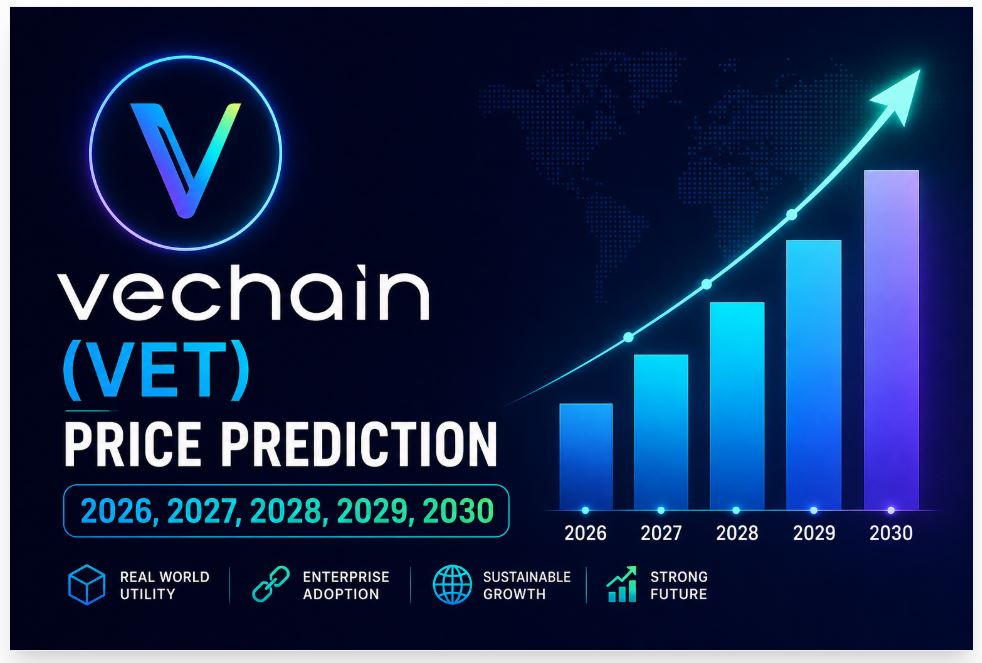
VeChain (VET) Price Prediction 2026, 2027, 2028, 2029, and 2030
VET trades near $0.0056 after rebounding sharply from the $0.0044-$0.0045 support zone, with momentum improving as the token attempts to reclaim the $0.0060-$0.0062 resistance area.
This article covers VET’s price forecast across 2026, 2027, 2028, 2029, and 2030, based on technical analysis, VeChain’s evolving tokenomics, network adoption, staking activity, and the long-term potential of the VeChain Renaissance roadmap.
Fundamental Analysis of VeChain
VeChain is a Layer-1 blockchain focused on real-world applications, enterprise adoption, sustainability, digital product passports, and increasingly, AI-powered applications. The network has delivered more than 100 enterprise applications and hundreds of millions of transactions for business clients, while the VeBetter ecosystem has become a major component of its consumer-facing adoption strategy.
VeChain’s Hayabusa upgrade fundamentally changed the VET investment thesis, moving VeChainThor from Proof of Authority toward public, permissionless Delegated Proof of Stake. VET holders can now stake or delegate their tokens, while protocol rewards are increasingly tied to network participation. VeChain states that total VET staked through StarGate grew from 2.52 billion to 13 billion tokens following the upgrade.
The network’s tokenomics have also become more deflationary at the transaction layer. VeChain now burns 100% of VTHO used as the base transaction fee, while Hayabusa reduced overall VTHO production and shifted generated VTHO rewards toward staked VET and network participants. This creates a stronger connection between blockchain activity, VTHO consumption, and the economic value of the VeChain ecosystem.
VeChain’s 2026 roadmap introduces an AI-focused narrative, positioning VeChainThor as a potential trust and transaction layer for an economy increasingly operated by autonomous AI agents. AgentSuite is part of this strategy, while the broader roadmap focuses on scalability, interoperability, intelligence, and real-world adoption.
The next major catalyst is Interstellar, the third phase of the VeChain Renaissance. Its first proposed upgrade, VIP-255, would bring VeChainThor closer to modern Ethereum compatibility by incorporating improvements from Ethereum’s Cancun, Prague, and Osaka releases. The proposal entered stakeholder voting in August 2026.
However, VeChain still faces significant challenges. VET remains far below its previous cycle highs, and real-world adoption has not yet translated into comparable token price appreciation. The ecosystem also needs sustained transaction growth, developer adoption, and stronger demand for VTHO to establish a durable value-accrual model for VET.
VeChain (VET) Price Prediction for 2026
2026 represents a transition year for VeChain as the network moves from the Hayabusa transformation toward the Interstellar phase. VET’s minimum forecasted price is $0.0048, while the maximum reaches $0.0120 by year-end, reflecting the potential for a recovery if the current breakout develops into a sustained trend.
| Month | Minimum Price ($) | Average Price ($) | Maximum Price ($) |
|---|---|---|---|
| January | 0.0062 | 0.0070 | 0.0082 |
| February | 0.0059 | 0.0067 | 0.0079 |
| March | 0.0056 | 0.0064 | 0.0076 |
| April | 0.0053 | 0.0061 | 0.0073 |
| May | 0.0051 | 0.0059 | 0.0070 |
| June | 0.0049 | 0.0057 | 0.0068 |
| July | 0.0048 | 0.0055 | 0.0067 |
| August | 0.0050 | 0.0058 | 0.0072 |
| September | 0.0052 | 0.0061 | 0.0078 |
| October | 0.0055 | 0.0065 | 0.0085 |
| November | 0.0058 | 0.0070 | 0.0100 |
| December | 0.0060 | 0.0075 | 0.0120 |
Bullish View: A sustained close above the $0.0060-$0.0062 resistance zone could confirm a broader recovery and open the way toward $0.0072, followed by $0.0085 and potentially $0.0100-$0.0120. The recent move from approximately $0.0044 to above $0.0056 demonstrates that buyers are willing to defend the lower support region.
Bearish View: A failure to hold the $0.0050 area could send VET back toward $0.0044, with a deeper breakdown exposing the $0.0042-$0.0043 region. Despite the improving ecosystem fundamentals, VET remains vulnerable to broader altcoin weakness and must establish sustained demand above the $0.0060 area before the recovery can be considered structurally confirmed.
Explore Potential of Another Layer-1 Gem: Solana Price Outlook
VeChain (VET) Price Prediction for 2027
2027 could become the year when VeChain’s upgraded economic model begins translating into stronger network participation and token demand. The minimum forecasted price is $0.0065, while the maximum reaches $0.0180.
| Month | Minimum Price ($) | Average Price ($) | Maximum Price ($) |
|---|---|---|---|
| January | 0.0065 | 0.0080 | 0.0120 |
| February | 0.0068 | 0.0083 | 0.0125 |
| March | 0.0070 | 0.0086 | 0.0130 |
| April | 0.0072 | 0.0089 | 0.0135 |
| May | 0.0074 | 0.0092 | 0.0140 |
| June | 0.0076 | 0.0095 | 0.0145 |
| July | 0.0078 | 0.0098 | 0.0150 |
| August | 0.0080 | 0.0101 | 0.0155 |
| September | 0.0082 | 0.0104 | 0.0160 |
| October | 0.0084 | 0.0107 | 0.0165 |
| November | 0.0086 | 0.0110 | 0.0172 |
| December | 0.0088 | 0.0113 | 0.0180 |
Bullish View: VeChain’s transition to DPoS and its staking-based economic model could create a stronger incentive for long-term VET ownership. The expansion of VeBetter, increasing staking participation, and continued development of Ethereum-compatible infrastructure could attract additional users and developers. VeChain’s roadmap specifically targets interoperability and broader Web3 integration, which could expand the network beyond its traditional enterprise focus.
Bearish View: VET could continue to underperform if ecosystem growth fails to generate meaningful token demand. The relationship between VET staking, VTHO generation, and actual network usage is still developing, while competition from established Layer-1 networks remains intense. A sustained move above the $0.01 level would be required to demonstrate that the market is assigning a significantly higher valuation to VeChain’s new economic model.
VeChain (VET) Price Prediction for 2028
By 2028, the market’s verdict on VeChain’s transformation should be clearer. The key question will be whether its enterprise foundation, sustainability applications, AI strategy, and EVM compatibility have produced enough real-world activity to create durable demand for the network’s tokens. The minimum forecasted price is $0.0090, while the maximum reaches $0.0250.
| Month | Minimum Price ($) | Average Price ($) | Maximum Price ($) |
|---|---|---|---|
| January | 0.0090 | 0.0120 | 0.0180 |
| February | 0.0093 | 0.0124 | 0.0185 |
| March | 0.0096 | 0.0128 | 0.0190 |
| April | 0.0099 | 0.0132 | 0.0195 |
| May | 0.0102 | 0.0136 | 0.0200 |
| June | 0.0105 | 0.0140 | 0.0210 |
| July | 0.0108 | 0.0144 | 0.0215 |
| August | 0.0111 | 0.0148 | 0.0220 |
| September | 0.0114 | 0.0152 | 0.0225 |
| October | 0.0117 | 0.0156 | 0.0230 |
| November | 0.0120 | 0.0160 | 0.0240 |
| December | 0.0123 | 0.0164 | 0.0250 |
Bullish View: VeChain’s long-term opportunity becomes significantly larger if the network succeeds in becoming a bridge between enterprise applications, AI agents, sustainability infrastructure, and the broader Ethereum ecosystem. Fuller EVM compatibility could reduce developer friction, allowing existing Ethereum tooling and applications to migrate more easily to VeChainThor.
The bullish scenario also assumes that higher blockchain activity leads to greater VTHO consumption and stronger economic activity across the network. Because 100% of VTHO used for base transaction fees is now burned, increasing usage could strengthen the network’s scarcity dynamics.
Bearish View: VeChain’s biggest risk is that technological upgrades do not translate into proportional economic activity. EVM compatibility alone does not guarantee developer adoption, while competing Layer-1 networks may continue to capture most new applications and liquidity. If transaction growth remains modest, VET could struggle to justify valuations above the $0.02 level.
VeChain (VET) Price Prediction for 2029
2029 tests whether VeChain has successfully transformed from an enterprise-focused blockchain into a broader Web3 infrastructure network. The minimum forecasted price is $0.012, while the maximum reaches $0.035.
| Month | Minimum Price ($) | Average Price ($) | Maximum Price ($) |
|---|---|---|---|
| January | 0.0120 | 0.0165 | 0.0250 |
| February | 0.0124 | 0.0170 | 0.0260 |
| March | 0.0128 | 0.0175 | 0.0270 |
| April | 0.0132 | 0.0180 | 0.0280 |
| May | 0.0136 | 0.0185 | 0.0290 |
| June | 0.0140 | 0.0190 | 0.0300 |
| July | 0.0144 | 0.0195 | 0.0310 |
| August | 0.0148 | 0.0200 | 0.0320 |
| September | 0.0152 | 0.0205 | 0.0330 |
| October | 0.0156 | 0.0210 | 0.0340 |
| November | 0.0160 | 0.0215 | 0.0345 |
| December | 0.0164 | 0.0220 | 0.0350 |
Bullish View: VeChain’s strongest long-term catalyst is the possibility that real-world blockchain adoption becomes economically meaningful at scale. Digital product passports, sustainability applications, tokenized assets, AI-agent transactions, and enterprise blockchain services could create recurring network activity rather than purely speculative demand.
If VeChain’s staking economy successfully aligns validators, delegators, builders, enterprises, and users, VET could benefit from a substantially stronger long-term demand profile. The DPoS transition was specifically designed to increase participation and align incentives across the network.
Bearish View: The primary risk is that VeChain remains technologically strong but economically underutilized. Enterprise partnerships and applications may generate headlines without creating enough VET demand to support a major revaluation. Competition from Ethereum Layer-2 networks and other high-throughput blockchains could also limit VeChain’s share of developer activity.
Must Read About The Future Potential of Another Layer-1: Cardano Price Predictions
VeChain (VET) Price Prediction for 2030
The 2030 scenario for VeChain depends on whether the project can establish itself as a major infrastructure layer for real-world applications, sustainable commerce, tokenized assets, and the emerging agentic economy. The minimum forecasted price is $0.015, while the maximum reaches $0.050.
| Month | Minimum Price ($) | Average Price ($) | Maximum Price ($) |
|---|---|---|---|
| January | 0.0150 | 0.0210 | 0.0320 |
| February | 0.0155 | 0.0218 | 0.0340 |
| March | 0.0160 | 0.0226 | 0.0360 |
| April | 0.0165 | 0.0234 | 0.0380 |
| May | 0.0170 | 0.0242 | 0.0400 |
| June | 0.0175 | 0.0250 | 0.0420 |
| July | 0.0180 | 0.0258 | 0.0435 |
| August | 0.0185 | 0.0266 | 0.0450 |
| September | 0.0190 | 0.0274 | 0.0460 |
| October | 0.0195 | 0.0282 | 0.0470 |
| November | 0.0200 | 0.0290 | 0.0485 |
| December | 0.0205 | 0.0300 | 0.0500 |
Bullish View: By 2030, VeChain could benefit from the convergence of several narratives: real-world blockchain adoption, enterprise tokenization, sustainability, AI agents, staking, and Ethereum-compatible infrastructure. VeChain’s 2026 roadmap explicitly envisions VeChainThor becoming a trust layer for an economy where billions of AI agents interact, transact, and exchange value.
The successful completion of the Renaissance roadmap could also make VeChain significantly easier for developers to use. Interstellar’s goal of bringing VeChainThor closer to Ethereum compatibility could remove one of the biggest historical barriers to ecosystem expansion and make existing Web3 development tools more accessible.
Under this scenario, sustained enterprise adoption combined with high network activity could push VET toward the $0.05 level, representing a substantial recovery from current prices.
Bearish View: The biggest concern is execution. VeChain has ambitious technology, but the market ultimately values blockchain networks according to usage, liquidity, developer activity, and sustainable economic demand. If AI, enterprise adoption, and Web3 applications develop elsewhere, VeChain could remain a niche infrastructure network despite its technical improvements.
VET’s long-term valuation also depends on how effectively value flows between VET staking, VTHO generation, VTHO burning, and actual network usage. If adoption grows slower than expected, the token may deliver only modest appreciation even if the underlying technology continues improving.
Overall, VeChain’s 2026-2030 outlook is increasingly tied to utility rather than speculation. The transition to DPoS, redesigned VTHO economics, VeBetter’s expansion, and the proposed Interstellar upgrade give VET a stronger fundamental narrative than it had several years ago. However, the key test remains whether these upgrades can translate into sustained economic activity and demand for the VeChain ecosystem.