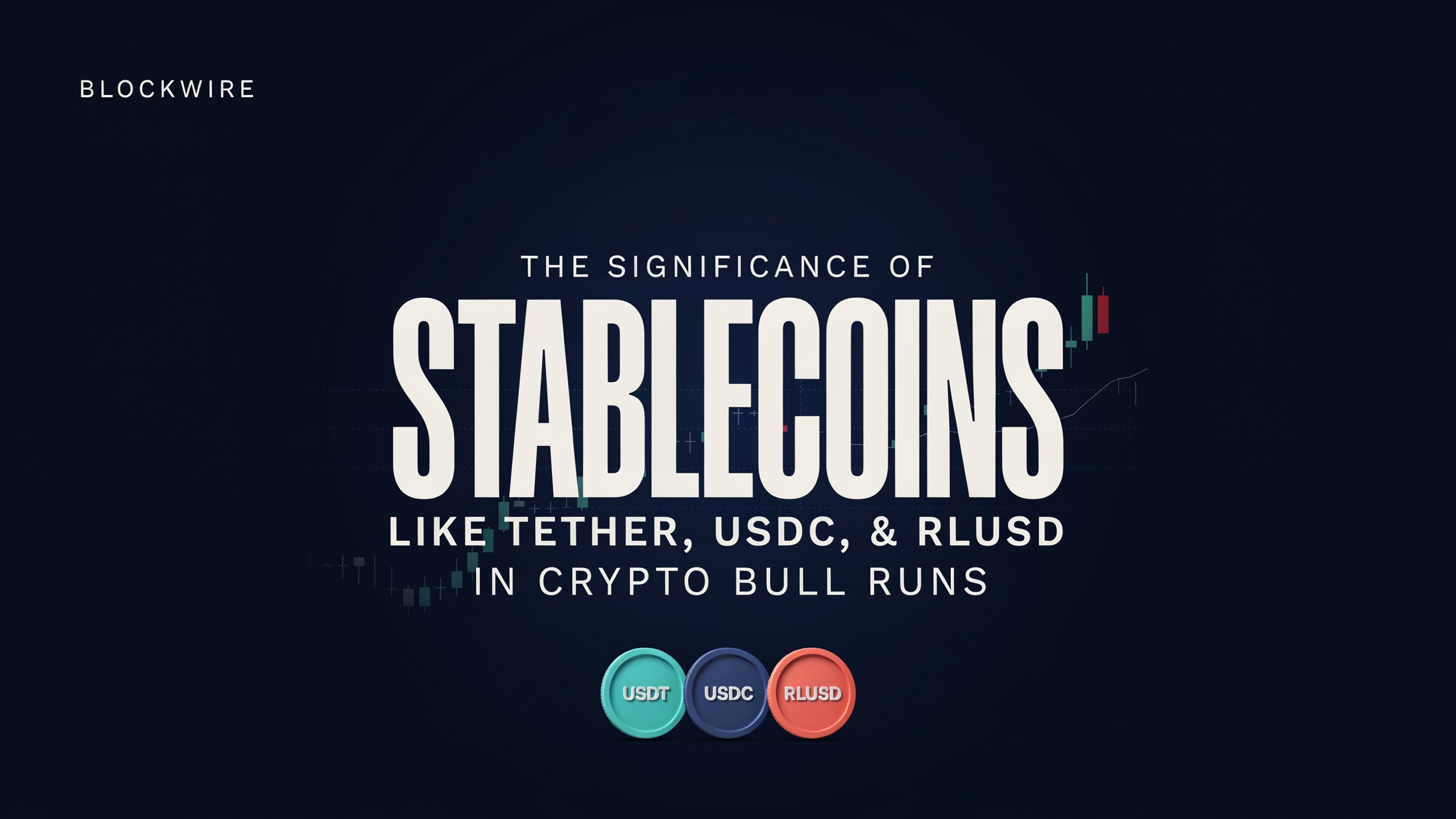
The Significance of Stablecoins Like Tether, USDC, and RLUSD in Crypto Bull Runs
Every crypto bull run has a story. In 2017, it was ICOs. In 2021, it was DeFi and NFTs. The next one? It is being written in dollars. Not the kind that sit in a bank account, but the kind that live on blockchains: stablecoins.
Here is the uncomfortable truth most traders ignore until it is too late. You cannot buy Bitcoin with conviction if your capital is stuck in a bank wire that takes three days. You cannot rotate from a winning altcoin into a new position at 3 AM if you have to convert to fiat first.
Stablecoins solved this. They became the plumbing of crypto markets. And in a bull run, plumbing matters more than price predictions.
But not all stablecoins are equal. Tether (USDT), USD Coin (USDC), and Ripple’s RLUSD each play different roles. Understanding those roles is the difference between catching a wave and watching it from the shore.
The Liquidity Engine That Never Sleeps
The single most important number in crypto is not Bitcoin’s price. It is the total stablecoin market cap. When that number rises, bull runs follow. When it falls, rallies stall.
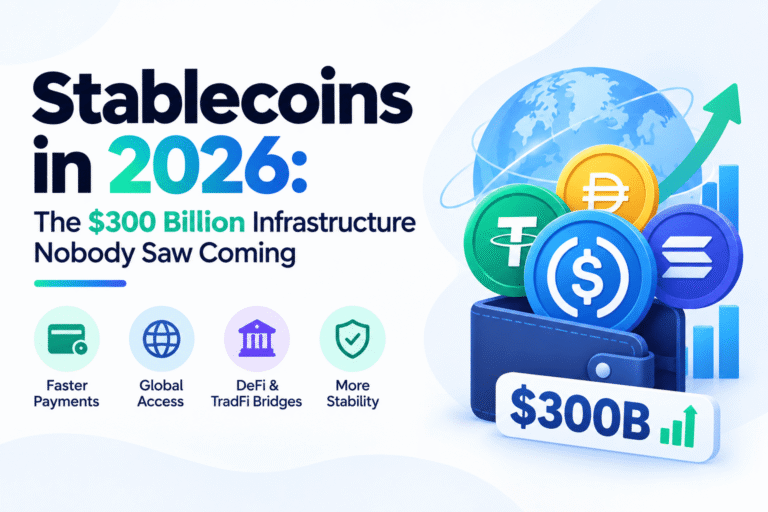
CryptoQuant’s research confirmed this in August 2026: stablecoin expansion is a leading indicator for sustained crypto gains. Their data showed total stablecoin market cap hitting an all-time high of $204 billion shortly after the 2024 U.S. presidential election, a $37 billion surge in weeks. By September 2026, that figure had ballooned past $300 billion.
Why does this matter? Because stablecoins are dry powder. When USDT deposits on exchanges climb, traders are preparing to buy. CryptoQuant tracked USDT exchange deposits jumping from $30.5 billion to $43 billion in a single period, a 41% increase. That is not speculation. That is ammunition being loaded.
“The total value of stablecoins is an important source of liquidity for trading on exchanges and its expansion is generally associated with higher crypto prices,” CryptoQuant analysts wrote.
The inverse is equally true. When stablecoin market caps contract, it signals capital leaving the battlefield. In 2022’s bear market, stablecoin shrinkage preceded the deepest drawdowns.
Tether: The Dominant, Controversial Backbone
Tether launched in June 2014, originally through Bitfinex, with a simple promise: one USDT equals one dollar, always redeemable. It was not the first stablecoin attempt, but it became the first to achieve real network effects.
By September 2026, Tether’s market cap stood at approximately $183.4 billion, commanding roughly 60% of the entire stablecoin market. That is not just dominance. That is monopoly territory.
Critics have spent years questioning Tether’s reserves, transparency, and relationship with Bitfinex. Yet USDT remains the default trading pair on most centralized exchanges, particularly in Asia. When a trader in Seoul or Singapore wants to exit a volatile position without touching a bank, USDT is the path of least resistance.
The numbers tell the story of usage, not just market cap. In 2024, stablecoin transfer volume reached $27.6 trillion, surpassing the combined transaction volume of Visa and Mastercard by over 7.6%. Tether facilitates the majority of that flow. While 70% of transaction volume was bot-driven, the sheer scale reveals how deeply stablecoins have embedded themselves in crypto’s circulatory system.
Tether’s role in bull runs is straightforward. It is the liquidity layer of last resort. When fiat banking rails are slow, expensive, or unavailable, USDT moves value at the speed of a blockchain confirmation. It is not elegant. It is essential.
USDC: The Institutional Bridge
Circle, founded in October 2013 by Jeremy Allaire and Sean Neville, launched USDC in 2018 through the Centre consortium with Coinbase. From day one, USDC positioned itself as the compliant alternative. Fully backed by cash and short-term U.S. Treasuries. Regular attestations. A deliberate contrast to Tether’s opacity.
The strategy worked. By September 2026, USDC’s market cap reached approximately $73.7 billion, making it the second-largest stablecoin and, together with USDT, accounting for over 81% of the stablecoin market.
But USDC’s true significance lies beyond its market cap. It is the stablecoin that traditional finance actually uses. Visa processes USDC transactions. Stripe integrated it. PayPal’s PYUSD exists partly because Circle proved regulated stablecoins could work at scale.
Circle’s journey culminated in its June 2025 IPO, the first pure-play stablecoin company to list on the NYSE. The offering priced at $31 per share, opened at $69, and raised approximately $1.1 billion. By July 2026, Circle had secured a national trust bank charter from the OCC, placing it closer to traditional banking infrastructure than any crypto-native competitor.
In a bull run, USDC serves a different function than USDT. It is the on-ramp for institutional capital. A hedge fund that will not touch USDT due to reserve concerns will hold USDC. A fintech company building payment rails will integrate USDC. When that capital eventually rotates into Bitcoin or Ethereum, USDC is the vehicle.
There is a trade-off. USDC’s compliance-first approach makes it vulnerable to regulatory shifts and slower to innovate. But in a market increasingly shaped by institutional flows, that trade-off may be worth it.
RLUSD: The Newcomer With Institutional Ambitions
Ripple launched RLUSD in December 2024, making it the youngest major stablecoin in the top ten. By late September 2026, its market cap approached $2.5 billion, a remarkable climb from near-zero less than two years prior.
RLUSD is issued under New York Department of Financial Services supervision, a regulatory standard that exceeds most competitors. It runs primarily on the XRP Ledger and Ethereum, with Ripple’s Ripple Mint service allowing institutional clients to create and redeem tokens directly through APIs.
The stablecoin’s growth is not speculative. It reflects real institutional demand. Ripple reported that its clients handle an estimated $13 trillion in annual payments, and RLUSD is positioned as the settlement layer for that flow. In August 2026, Ripple joined Clearpool and Cicada on a planned institutional credit fund denominated in RLUSD.
On the XRP Ledger itself, RLUSD dominates. As of September 2026, it accounted for approximately $1.1 billion of the ledger’s $1.19 billion in total stablecoin supply, or 92%.
For bull runs, RLUSD represents something new: a stablecoin built for cross-border settlement, not just trading. When payment corridors open between institutions, capital does not need to touch a bank. It moves on-chain, settles in seconds, and the recipient holds a regulated dollar token. That is not a trading tool. That is infrastructure.
What the Data Actually Says
The stablecoin market has consolidated dramatically. ARK Invest’s research in September 2026 noted that only two stablecoins exceed $10 billion in market cap: Tether and Circle. The next tier, including RLUSD, PYUSD, and DAI, hovers in the single-digit billions.
This concentration matters. It means liquidity begets liquidity. USDT and USDC have the deepest order books, the most exchange integrations, and the strongest network effects. Newer stablecoins must offer something different: RLUSD has Ripple’s payment network. PYUSD has PayPal’s consumer reach. USDe has DeFi yield.
For traders, the implication is simple. Watch stablecoin flows, not just prices. When USDT and USDC market caps climb, capital is entering the ecosystem. When exchange stablecoin reserves spike, buying pressure is building. When stablecoin transfer volume surges, the market is rotating, not exiting.
The numbers from 2026 paint a clear picture. Total stablecoin market cap: over $300 billion. Annual transfer volume: $27.6 trillion, exceeding Visa and Mastercard combined. Stablecoin-funded card purchases: $1.03 billion in July 2026 alone, up nearly 200% year-over-year.
These are not crypto-native metrics anymore. These are financial infrastructure metrics.
The Risks That Do Not Disappear
No honest discussion of stablecoins can ignore the threats. Regulatory uncertainty remains the largest. India’s central bank, for instance, has repeatedly advocated for policies “leaning towards prohibition,” warning that stablecoins threaten monetary sovereignty and could reduce seigniorage income. While India’s 39 million crypto users continue trading in a grey zone, the RBI’s stance reflects a broader global tension.
Reserve transparency is another. Tether has faced years of skepticism, though it completed a full audit in 2026. Circle publishes regular attestations but remains exposed to interest rate movements that fund its reserves. RLUSD is new enough that its long-term resilience is untested.
There is also the de-pegging risk. In extreme market stress, stablecoins can break their $1 anchor, as USDC briefly did during the March 2023 banking crisis. For traders using stablecoins as collateral, that is not a theoretical concern. It is a margin call waiting to happen.
Conclusion
Bull runs do not start with price charts. They start with liquidity. Stablecoins are the liquidity layer of modern crypto. Tether provides the raw volume that keeps exchanges functioning. USDC provides the institutional credibility that brings traditional capital on-chain. RLUSD provides the settlement infrastructure for payments that do not need to touch a bank.
The next bull run will not be won by traders who predict the top. It will be won by those who understand where the money is, how it moves, and what it costs to move it. Stablecoins are not a sideshow. They are the engine room. And in September 2026, that engine is running hotter than ever.
The data is clear. The question is whether you are watching it.