Curve DAO Review: The Backbone of Stablecoin Liquidity and the Power of CRV

If you’ve spent any meaningful time in decentralized finance, you’ve likely encountered Curve Finance. It’s the protocol that quietly powers billions of dollars in stablecoin swaps every day, the place where institutional-sized trades happen with almost zero slippage, and the project that sparked the legendary “Curve Wars.”
But what exactly is Curve DAO, how does the CRV token fit into the picture, and is it still relevant in today’s multi-chain landscape?
This review cuts through the noise and gives you a practical, no-nonsense breakdown.
What Is Curve DAO?
Curve Finance launched in early 2020, founded by Michael Egorov, a physicist and software engineer who previously co-founded NuCypher. The core problem Egorov set out to solve was straightforward yet technically complex: existing automated market makers like Uniswap weren’t designed for assets that trade at similar values.
Swapping USDC for USDT on a general-purpose AMM often meant eating unnecessary slippage, which became prohibitively expensive for large trades.
Curve solved this with its StableSwap invariant, a mathematical formula that combines constant sum and constant product market makers to concentrate liquidity tightly around a 1:1 peg. The result? A $1 million USDC-to-USDT swap on Curve might incur less than 0.01% slippage, whereas on other platforms, that same trade could easily cost thousands of dollars in price impact.
The DAO component came in August 2020, when the CRV governance token and DAO contracts were deployed.
Notably, this wasn’t done by the Curve team itself but by an anonymous community member who used publicly available code, a move that underscored Curve’s commitment to decentralization from the start.
Today, Curve operates across more than 30 chains and has expanded beyond stablecoins into volatile asset pairs through Cryptoswap pools, foreign exchange pools, and its native stablecoin, crvUSD.
Curve’s Technology Working Mechanism:
Understanding Curve requires grasping two distinct pool types, each engineered for specific asset categories.
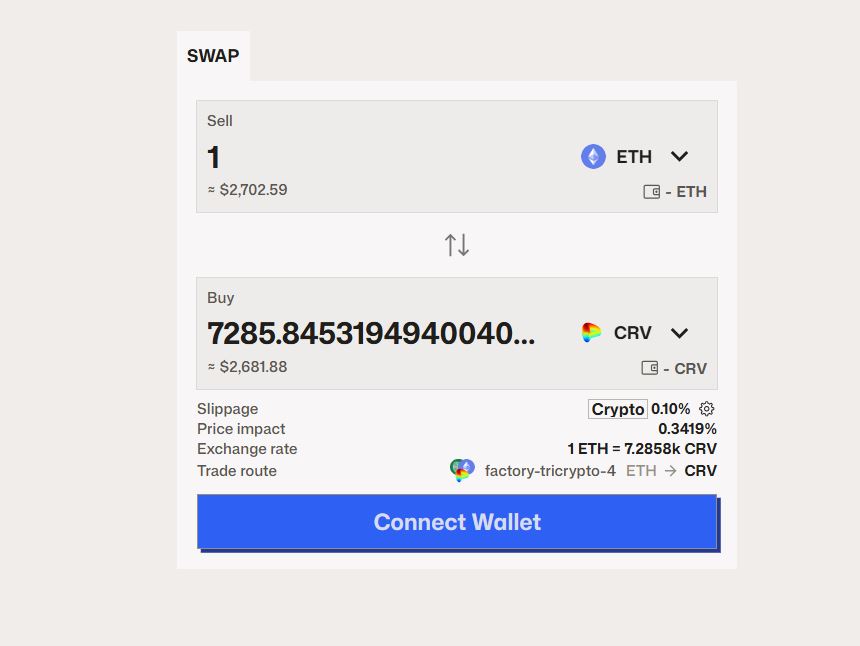
StableSwap Pools handle assets that should trade at a fixed ratio: stablecoins like USDC and USDT, liquid staking derivatives like stETH and ETH, or yield-bearing tokens like sUSDe. These pools are fully passive for liquidity providers, meaning you deposit your assets and earn fees without needing to actively manage positions.
The algorithm automatically concentrates liquidity around the peg, making even massive trades capital-efficient.
CryptoSwap Pools, introduced in 2021, extend the same efficiency principle to volatile pairs like ETH/WBTC. Unlike Uniswap v3, where LPs must manually set price ranges, CryptoSwap automatically rebalances liquidity around the current price using accrued trading fees to cover rebalancing costs.
The table below summarizes the key differences:
| Feature | StableSwap Pools | CryptoSwap Pools |
|---|---|---|
| Asset Type | Pegged assets (USDC/USDT, stETH/ETH) | Volatile assets (ETH/WBTC) |
| Number of Assets | 2 to 8 | 2 or 3 |
| LP Management | Fully passive | Automated rebalancing |
| Primary Goal | Ultra-low slippage near peg | Efficient volatile trading |
Transaction Fees:
One of Curve’s most attractive features is its fee structure. The protocol charges no frontend fees on any of its products, meaning you’re only paying the pool’s trading fee and the blockchain’s gas fee.
The trading fee is typically around 0.04%, paid directly to liquidity providers of the pool you’re using. This fee is already baked into the exchange rate you see in the interface, so there are no hidden charges. Gas fees go entirely to the network, not to Curve.
This structure often results in better final prices on Curve compared to aggregators, simply because there are fewer layers taking a cut.
The CRV Token and the veCRV Model
CRV is far more than a standard governance token. It’s the engine that drives Curve’s entire incentive structure through a system called veTokenomics, which Curve pioneered and which has since been copied by dozens of protocols.
Here’s how it works. Users lock their CRV tokens for a period of up to four years to receive veCRV (vote-escrowed CRV). The longer you lock, the more voting power you receive. This mechanism serves several critical functions:
Gauge Weight Voting: Each week, veCRV holders vote on which liquidity pools should receive CRV emissions. This is the core of Curve’s governance, and it’s what made the Curve Wars so intense.
Protocols competing for liquidity needed veCRV, or influence over those who held it, to direct rewards to their pools.
Fee Sharing: veCRV holders earn 50% of all protocol trading fees. This provides a direct, sustainable yield for long-term lockers, independent of token emissions.
Boosted Rewards: Liquidity providers who hold veCRV can boost their CRV rewards by up to 2.5x. This creates a powerful incentive to both provide liquidity and lock tokens.
The total supply of CRV is capped at 3.03 billion tokens, with 62% allocated to community emissions and liquidity providers. Importantly, all original team and investor vesting schedules concluded by late 2024, removing a significant source of selling pressure that had historically weighed on the token.
Real-World Utility: crvUSD and Llamalend
Curve’s ambitions extend well beyond swaps. In 2023, it launched crvUSD, a fully decentralized, overcollateralized stablecoin. What makes crvUSD unique is its LLAMMA (Lending-Liquidating AMM Algorithm), which replaces traditional hard liquidations with a gradual process.
Instead of your collateral being liquidated all at once when price hits a threshold, LLAMMA gradually converts collateral into stablecoins across a price range, and can automatically rebuy it if the price recovers.
This design enables exceptionally high loan-to-value ratios and has proven resilient during market volatility. By 2026, crvUSD reached multi-billion dollar market cap, and its LLAMMA mechanism protected 99% of user collateral during 10% price swings.
Building on this, Llamalend launched in early 2024 as a lending protocol powered by the same LLAMMA engine. Llamalend v2, launched on Optimism in June 2026 with a 250,000 OP grant, removes the previous restriction to crvUSD pairs, allowing markets with virtually any collateral and borrow asset combination, including Curve LP tokens as collateral.
Community Overview:
Online sentiment around Curve DAO is polarized, which itself tells you something important: the project is significant enough to generate strong opinions.
On Reddit, the dominant narrative positions CRV as a stablecoin infrastructure play. One widely echoed sentiment is that “CRV is the plumbing needed for stablecoins”. Users frequently highlight Curve’s role as the primary liquidity venue for stablecoins and draw comparisons to XRP in terms of utility-focused investment theses.
The emergence of Forex pools (USD/EUR, USD/CNH) with slippage under 2% has reinforced this view for traders looking at on-chain currency exchange.
However, skepticism exists. Some Reddit users point out that CRV is down significantly from its all-time highs and question whether the token can recapture previous valuations. The Chinese community analysis notes that CRV’s original innovation, StableSwap, has been absorbed by competitors like Uniswap V4 Hooks and Balancer, and that the market no longer pays a premium for being “the inventor”.
The veCRV model has been widely copied, reducing its differentiation.
Trust Wallet’s educational content presents Curve in a neutral, educational light, emphasizing its role as a DEX for low-slippage stablecoin trading and the governance function of CRV.
The focus there is on practical use: buying, holding, and using CRV within a secure wallet environment.
Risks You Should Understand
No serious review of Curve DAO would be complete without addressing the risks.
Smart Contract Complexity: Curve’s codebase is highly specialized, written in Vyper, a Python-derived language. While battle-tested, its complex pool structures mean any vulnerability could have systemic implications across DeFi.
Founder Concentration Risk: Michael Egorov has historically held large CRV-backed loans. In 2023, these nearly faced liquidation during market stress, causing significant volatility. While this situation has been managed, it highlighted a centralization risk that persists in the protocol’s leadership structure.
Competitive Pressure: Curve’s moat is its liquidity depth and network effects. But competitors are increasingly capable of replicating its efficiency. The protocol’s ability to maintain its position as the default venue for large stablecoin swaps is not guaranteed.
Conclusion
Curve DAO remains foundational infrastructure for DeFi. Its StableSwap algorithm solved a real problem that general-purpose AMMs still struggle with, and its veCRV governance model reshaped how protocols think about liquidity incentives.
The CRV token provides genuine utility through governance, fee sharing, and reward boosting.
That said, Curve is no longer the only game in town. Its innovation has been absorbed across the ecosystem, and the token’s value proposition depends heavily on continued volume and the success of crvUSD.
For users who prioritize efficient stablecoin swaps with minimal slippage, Curve is still the best tool available.
And foror investors, the thesis rests on whether Curve can maintain its liquidity dominance as competition intensifies.
Frequently Asked Questions
Find simple answers to common questions about Curve DAO, CRV, veCRV, Curve Finance and crvUSD.
Curve DAO is the governance system for Curve Finance, a decentralized exchange specialized in low-slippage trading of stablecoins and similar assets. CRV holders can lock their tokens to vote on governance decisions and participate in fee sharing and other protocol benefits.
CRV is Curve’s tradeable governance token. veCRV is received when CRV is locked for a selected period of up to four years. veCRV provides voting power, fee-sharing benefits and liquidity-provider reward boosts. Unlike CRV, veCRV is non-transferable and remains locked for the selected period.
Curve does not charge a separate frontend fee. The protocol charges a pool trading fee, which is typically around 0.04%, although the exact fee can vary by pool. Users also need to pay gas fees to the blockchain network when making transactions.
The Curve Wars refers to the competition among DeFi protocols to accumulate veCRV or influence veCRV holders. This is important because Curve gauge weights influence where CRV emissions are directed. Protocols such as Convex Finance became prominent by helping aggregate and maximize veCRV-related voting power.
crvUSD is Curve’s native decentralized stablecoin. It uses the LLAMMA algorithm, which is designed to gradually convert collateral as market prices move instead of relying only on a traditional hard liquidation. This approach is intended to provide smoother risk management and support higher loan-to-value ratios.
The maximum supply of CRV is 3,030,303,031 tokens. No new tokens can be minted beyond this cap. CRV emissions are designed to continue for more than 200 years, with the emission rate declining over time at approximately 16% per year.
CRV is available on major cryptocurrency exchanges and decentralized exchanges. It can also be stored in self-custody wallets that support CRV across compatible blockchain networks. Users can swap for CRV directly on Curve or other supported decentralized exchanges.
Curve’s core smart contracts have undergone extensive security review and the protocol has a significant history in decentralized finance. However, no DeFi protocol is completely risk-free. Smart contract vulnerabilities, pool-specific risks and blockchain-related risks can lead to losses. Users should use reputable interfaces, review pool details and understand the risks before interacting with Curve.