Top 7 Catalysts Which Could Lead to Huge Bullish Move In Solana

Solana has always been a network that moves fast, sometimes too fast for its own good. But speed alone doesn’t drive value. What drives value is infrastructure that can handle real demand, institutions that bring real money, and applications that solve real problems.
The next two to three years could redefine Solana’s place in the market. Not because of hype cycles, but because of specific, measurable catalysts that are already in motion.
Here are seven catalysts that could trigger a significant bullish move in Solana, backed by data, dated events, and practical context.
Recommended Read: SOL Price Forecast based On Crypto Cycles
1. Firedancer’s Gradual Mainnet Rollout
Date: May 2026
Jump Crypto quietly launched Firedancer on Solana mainnet in May 2026. The new validator client, written from scratch in C, has already processed tens of millions of transactions in production .
This matters because Solana previously relied on a single validator client (Agave). A critical bug in that one client could take down the entire network. Firedancer provides independence and redundancy .
The engineering approach is telling. Firedancer’s architecture draws from traditional high-frequency trading systems, the kind built for Wall Street . The team also completed a public security audit with a $1 million bug bounty pool before broader deployment .
Why this is bullish: Firedancer could eventually help Solana handle up to 1 million transactions per second . More importantly, it reduces the risk of network outages that have plagued Solana during peak demand. For institutional users, reliability is non-negotiable.
2. Alpenglow Consensus Upgrade: 12.8 Seconds to 150 Milliseconds
Approved: September 2025 | Target Activation: Late 2026
In September 2025, Solana validators approved the Alpenglow upgrade with 98.27% of participating stake voting in favor . This is the most significant consensus change since Solana’s launch.
Here’s the headline number: finality currently takes about 12.8 seconds. Alpenglow targets 100 to 150 milliseconds .
Why does finality matter? When a transaction is “finalized,” it’s irreversible. Faster finality opens the door for applications that need instant settlement certainty. think high-frequency trading, point-of-sale payments, and institutional settlement systems .
There’s a second benefit that’s less discussed. Validator votes currently consume approximately 75% of all Solana transactions. Alpenglow moves voting off-chain, freeing that block space for actual user activity . That’s a massive capacity unlock.
| Metric | Current | After Alpenglow (Target) |
|---|---|---|
| Finality Time | 12.8 seconds | 100-150 milliseconds |
| Vote Transactions | ~75% of all transactions | Off-chain |
| Priority Fee Sharing | Validator only | Delegators eligible |
Why this is bullish: If Alpenglow delivers even half of its projected performance, Solana becomes the fastest settlement layer in crypto by a wide margin. That’s a competitive moat for DeFi, payments, and institutional adoption.
3. Spot Solana ETFs and Institutional Access
Approved: October 2025 | Trading Began: October 28, 2025
The SEC approved spot Solana ETFs in October 2025, making SOL the third cryptocurrency to receive spot ETF approval after Bitcoin and Ethereum . Trading began October 28, 2025.
Initial issuers included Bitwise, Grayscale, 21Shares, Franklin Templeton, Fidelity, and VanEck .
The institutional interest hasn’t stopped. In June 2026, Morgan Stanley filed for a spot Solana ETF with a 0.14% fee, the lowest in the U.S. market . That undercuts Franklin Templeton’s 0.19% and typical Ethereum ETF fees of 0.20-0.30% . When Morgan Stanley competes on price, it signals serious institutional conviction.
Why this is bullish: ETFs provide regulated exposure for traditional investors who can’t or won’t buy crypto directly. Lower fees attract more capital. More capital drives liquidity. Liquidity begets more institutional products. It’s a flywheel.
4. Stablecoin Dominance: 6 Million Monthly USDC Senders
Record Hit: August 2026
Solana now has approximately 6 million monthly USDC senders, more than any other blockchain . That’s not a one-month anomaly. It’s grown more than tenfold since late 2023 .
In February 2026, Solana processed $650 billion in stablecoin volume in a single month . By Q1 2026, Solana captured as much as 76% of global stablecoin transfer market share .
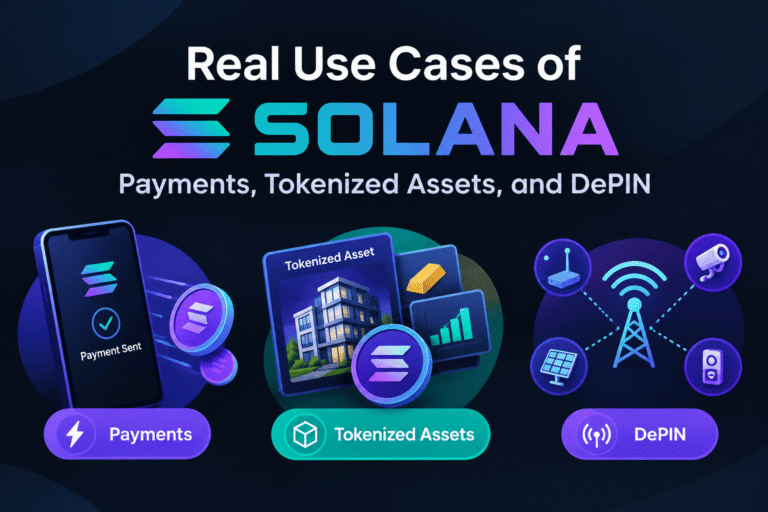
What’s driving this? Mundane, real-world use cases: salary disbursements, peer-to-peer transfers, and retail payments . These aren’t speculative trades. They’re people using crypto as money.
Why this is bullish: Stablecoin flows are the lifeblood of any blockchain. They represent real economic activity. When Solana becomes the default network for dollar transfers, it builds a base of users who don’t care about token prices, they care about cheap, fast transactions.
5. Tokenized Real-World Assets (RWA) Surpass $18.5 Billion
Data: September 2026
Solana’s real-world asset ecosystem has crossed $18.5 billion in total value . This includes stablecoins, tokenized funds, stocks, and commodities.
Breaking it down: stablecoins alone hit $16.4 billion in May 2026. Non-stablecoin RWAs climbed from $2.8 billion to $4.23 billion by September 2026 .
The issuer list reads like a financial services conference: BlackRock, Franklin Templeton, Ondo, Securitize, Circle, Tether . Franklin Templeton’s BENJI money market fund deployed on Solana following Ethereum and Stellar .
Perhaps the most striking statistic: Solana captured 97% of all on-chain tokenized equities trading volume in the first half of 2026 . Allium’s September 2026 report confirmed $14.7 billion in RWA spot volume over the past year, representing 32% of all on-chain RWA spot volume .
Why this is bullish: Tokenized assets are the bridge between traditional finance and crypto. When BlackRock and Franklin Templeton choose Solana, they’re not experimenting. They’re building infrastructure. That capital doesn’t leave easily.
6. The Revenue Reset: From Memecoins to Real Use
Data: H1 2026
This one requires context. Solana’s gross revenue fell 87.1% year-over-year to $141 million in H1 2026, down from $1.09 billion in H1 2025 .
That sounds alarming, until you understand why. Memecoin fees represented 95% of Solana’s H1 2025 revenue . That was unsustainable speculation, not organic demand.
The composition shift tells a different story:
- Memecoins: From 40% of spot volume (H1 2025) to 16% (H1 2026)
- Stablecoins: From 6% to 19%
- General trading: From 41% to 53%
Stablecoin assets under management grew 51% year-over-year, from $10.4 billion to $15.7 billion . Solana processed more than 22.5% of all global stablecoin transactions in H1 2026, with over $1.9 trillion in settled value .
Why this is bullish: A revenue collapse caused by memecoin speculation fading is healthy. It means the network is replacing gambling with utility. The annualized run rate of $282 million is lower, but the quality of that revenue is higher. When the next bull cycle comes, Solana won’t need memecoins to generate fees.
7. DePIN: 17x Data Offload Growth
Data: April 2026
Solana’s DePIN (Decentralized Physical Infrastructure Networks) sector generated $2.8 million in revenue in April 2026 . That’s modest by traditional standards. But the growth rate is what matters: data offload activity jumped 17x year-over-year .
Helium Mobile leads the category, generating over $14 million in cumulative revenue since January 2025, often surpassing $2 million per month on its own . Render provides decentralized GPU rendering. Hivemapper builds mapping data through dashcam contributions .
Cumulative tracked DePIN revenue on Solana has surpassed $22 million since January 2025 .
Why this is bullish: DePIN is one of the few crypto use cases that generates revenue from actual consumers, not speculators. Helium Mobile users route data through decentralized infrastructure because it’s cheaper, not because they’re crypto enthusiasts . If this model scales, Solana becomes the settlement layer for a new kind of telecom and infrastructure network.
The Bigger Picture
Solana’s bull case isn’t built on one catalyst. It’s built on stacked improvements: faster finality, more reliable infrastructure, institutional products, real payment flows, and tangible use cases.
The network is transitioning from a speculative playground to a settlement layer for real economic activity. That transition is messy revenue is down, memecoins are fading, and competition is fierce. But the metrics that matter for long-term value stablecoin senders, RWA value, institutional issuers, are all moving in the right direction.
The catalysts above aren’t promises. They’re dated events with measurable data. That’s what makes them worth watching over the next two to three years.