Bitcoin Real-World Use Cases: How Bitcoin Is Powering Payments, Digital Lending, and Everyday Crypto Adoption
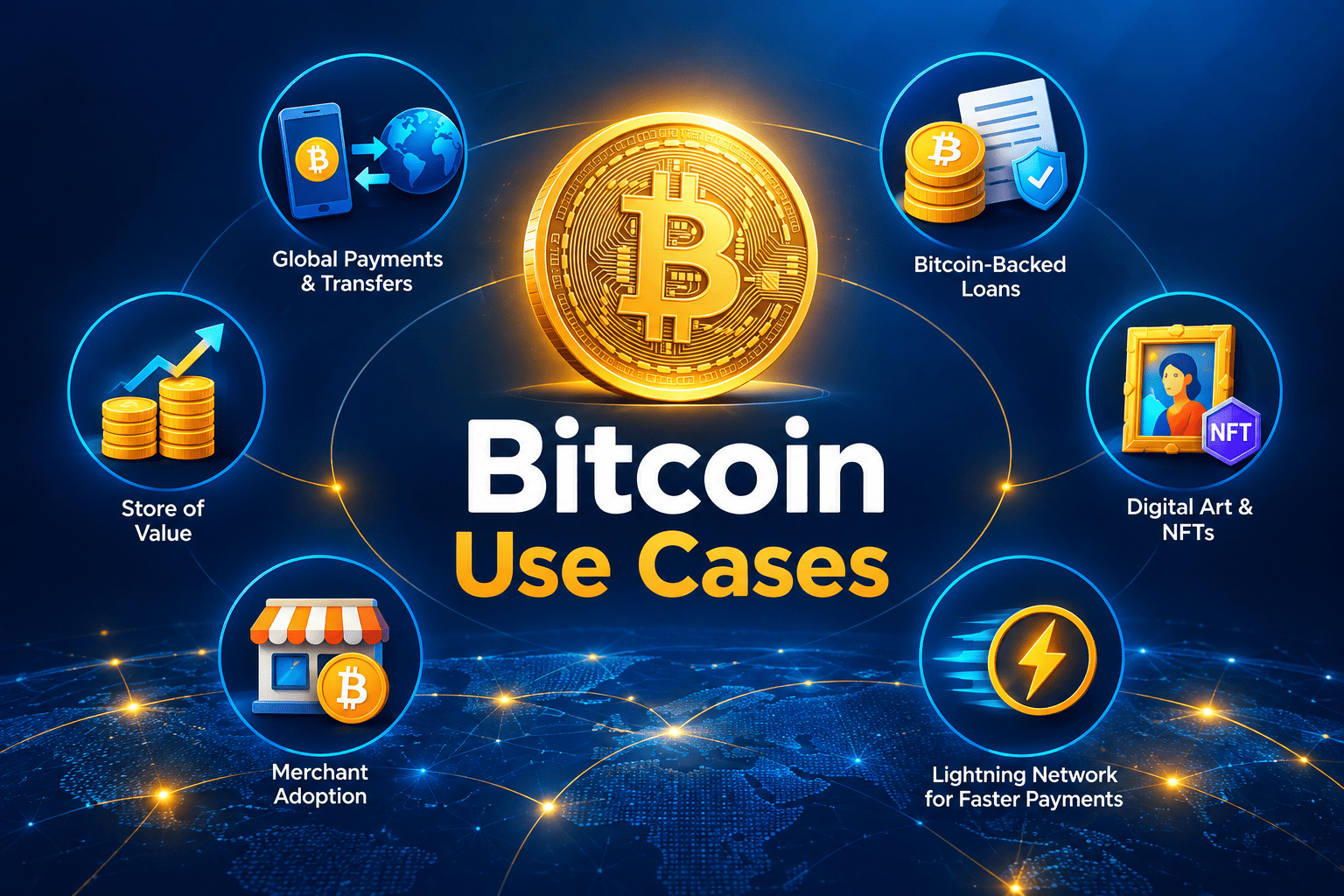
Bitcoin’s utility in 2026 is real, but it doesn’t look like the “buy coffee with BTC” vision from 2013. The actual use cases generating measurable traction are Lightning Network settlements for cross-border payments and exchange transfers, Bitcoin-backed lending that lets holders access liquidity without selling, and Ordinals inscriptions that have created a permanent on-chain artifact market.
This guide breaks down what’s working, what’s not, and what the data actually says.
When Bitcoin launched in January 2009, the whitepaper promised peer-to-peer electronic cash. For most of its first decade, that promise went largely unfulfilled. Transaction speeds were too slow, fees too high, and volatility too extreme for everyday commerce. That’s no longer the case, but the reality of Bitcoin’s use cases in 2026 is more nuanced than the headlines suggest.
Having spent over a decade in this sector, I’ve watched narratives rise and crash. The use cases that survived are the ones with real usage metrics behind them.
The Lightning Network: Bitcoin’s Settlement Layer Is Growing Fast
The Lightning Network, a Layer 2 protocol that moves transactions off Bitcoin’s base chain, has crossed a critical threshold. In early 2026, monthly transaction volume on Lightning surpassed $1 billion, up from $286.5 million a year earlier .
That’s a 4x increase in twelve months, and it changes the conversation about Bitcoin’s viability as a payment rail.
But here’s what most coverage gets wrong: Lightning isn’t primarily being used for coffee purchases. The average transaction size has grown to roughly 74,000 sats (about $50 at current prices), and experts confirm the volume is driven by exchange settlements and business-to-business transfers, not retail microtransactions .
Who’s Actually Using Lightning
Square rolled out Bitcoin payments to all US merchants (excluding New York) in November 2025, after piloting with 1,500+ merchants for over a year . The implementation is native, built into the same system sellers already use for cards and cash, with no fees until 2027 .
Merchants can choose to accept BTC or instantly convert to USD, and they’re automatically added to BTCMap when they enable the feature .
The community response on Reddit’s r/SquareOfficial AMA with Bitcoin Product Lead Miles Suter was notably positive.
One commenter asked about fiat-to-fiat payments on Bitcoin rails, and Suter confirmed the long-term goal is interoperability: “we believe bitcoin can be the interoperability layer between the current walled garden systems we have in the world” .
Kraken facilitated a $1 million Lightning transaction in February 2026, demonstrating that the network can handle high-value settlements, not just micropayments . Voltage’s VP of marketing told DL News that nearly 29% of Bitcoin transfers now pass through Lightning, with Coinbase routing around 15% of its transactions on the network .
The El Salvador Reality Check
El Salvador made Bitcoin legal tender in 2021 with promises of remittance savings and financial inclusion. Five years later, the data tells a sobering story.
Crypto remittances in H1 2026 totaled $35.4 million, representing just 0.7% of the country’s $5.06 billion in total remittance inflows . More than 84% of remittances still flow through banks and traditional money transfer companies .
The Chivo wallet, introduced with great fanfare, is being phased out under an IMF agreement . The lesson is clear: lower fees alone don’t change consumer behavior when trust, familiarity, and stability are on the line.
| Metric | Lightning Network | Base Chain |
|---|---|---|
| Average settlement time | Under 1 second | 10-60 minutes |
| Transaction fees | Fractions of a cent | $1-$20+ |
| Monthly volume (early 2026) | $1+ billion | Variable |
| Primary use cases | Exchange settlements, B2B payments | Large transfers, store of value |
Bitcoin-Backed Lending: Unlocking Liquidity Without Selling
One of Bitcoin’s persistent criticisms is that it’s a “barren asset” producing no yield. Bitcoin-backed lending directly addresses this. The premise: pledge BTC as collateral, receive a loan in stablecoins or fiat, keep your Bitcoin exposure, and avoid triggering a taxable sale.
Ledn, founded in 2018, has issued over $11 billion in cumulative loans and projects this figure could reach $1 trillion in the coming years . SALT Lending, which began offering BTC-backed loans in 2016, initially served Bitcoin miners but now reports applications from institutions and “Gen Xers and baby boomers” .
What Borrowers Are Actually Funding
According to SALT’s chief revenue officer, borrowers use these loans for college tuition, emergency expenses, and once-in-a-lifetime trips . Ledn’s retail clients borrow smaller amounts to cover income gaps, while wealth management clients finance real estate, business investments, and children’s education .
The key attraction is avoiding a taxable sale while maintaining Bitcoin exposure. Adam Reeds, Ledn’s co-founder and CEO, explained that many customers renew their loans precisely because they want to hold their BTC long-term .
New Entrants Signal Institutional Validation
Ledger launched Crypto Loan in October 2026, a self-custodial feature allowing users to pledge wrapped Bitcoin (cbBTC or wBTC) as collateral to borrow USDC or USDT, all managed within the Ledger Wallet with hardware confirmation required for key actions .
The feature runs on Morpho, the same infrastructure Coinbase uses for its Bitcoin-backed loans .
Coinbase introduced fixed-rate BTC-backed loans through Morpho’s Midnight protocol, offering USDC with predetermined interest rates and repayment dates. The platform already had over $1.4 billion in outstanding loans and approximately $3 billion in collateral .
Community sentiment on r/CryptoCurrency and r/Bitcoin reflects a split. Supporters see BTC-backed loans as the logical evolution of Bitcoin as a financial asset.
Critics point to the 2022 contagion that wiped out Celsius and BlockFi, warning that liquidation risk is real. The consensus favors regulated lenders with conservative loan-to-value ratios over yield-chasing platforms.
Bitcoin Ordinals: On-Chain Artifacts with Real Data
The Ordinals protocol, launched by Casey Rodarmor in January 2023, gave Bitcoin a native way to own unique digital assets entirely on-chain. Unlike Ethereum NFTs that typically store metadata externally, Ordinals embed the actual file data directly into Bitcoin’s blockchain through the witness field.
Glassnode data shows over 5.6 million text/BRC-20 inscriptions and 3.1 million image inscriptions as of mid-2026 . The cumulative data size for BRC-20 text inscriptions alone exceeds 5.6 GB, with image inscriptions totaling over 23 GB .
| Inscription Type | Count (Q3 2026) | Data Size |
|---|---|---|
| Text/BRC-20 | 5,614,236 | 5.6 GB |
| Image | 3,123,370 | 23.4 GB |
| Text (non-BRC-20) | 16,254,867 | 3.6 GB |
| Other | 2,672,902 | 794 MB |
| Video | 137,058 | 243 MB |
| Audio | 1,898 | 182 MB |
The community remains divided. On r/Bitcoin, purists argue inscriptions spam the network and drive up fees. Proponents counter that inscription fees have become a meaningful revenue stream for miners as block subsidies decline. The market has voted with its wallet: inscription activity remains robust.
Bitcoin in Unstable Economies: Store of Value or Failed Promise?
Bitcoin’s most organic use case is wealth preservation when local currencies fail. But the evidence is mixed.
Iran introduced a Bitcoin-based maritime insurance platform called “Hormuz Safe” for vessels in the Persian Gulf and Strait of Hormuz, enabling payments and settlements in Bitcoin and other crypto. The platform is explicitly designed to work around normal banking channels and SWIFT, especially given regional tensions .
In El Salvador, the story is different. Despite legal tender status and government incentives, Bitcoin remittances remain below 1% of total inflows .
A Binance Square analysis concluded that “lower transaction costs alone are not enough to change consumer behavior,” noting that families prioritize reliability, easy access, customer support, and stable purchasing power .
Nasdaq published a critical assessment in January 2026 noting that over the past 12 months, gold’s price increased by 84% while Bitcoin’s declined by 14% . The article argued that Bitcoin “certainly isn’t performing anything like the shiny metal at the moment” and warned against over-allocating on the assumption that it will protect wealth the way gold historically has .
Conclusion
Bitcoin’s use cases in 2026 are measurable, but they don’t match the original “electronic cash” vision. Lightning is growing fast but primarily serves settlements and B2B transfers. Bitcoin-backed lending has crossed $11 billion in cumulative volume and is attracting institutional players.
Ordinals have created a permanent on-chain artifact market with millions of inscriptions. And in unstable economies, Bitcoin’s store-of-value narrative faces real challenges, as El Salvador’s remittance data shows.
The common thread: Bitcoin’s utility is expanding, but adoption follows trust and convenience, not ideology. The infrastructure is here. The usage data is real. The debate about what Bitcoin is “for” is being answered in production, one block at a time.