Dual Finance Review 2026
If you’ve spent any time in DeFi over the past few cycles, you know the drill. A protocol launches with a splashy token, emissions flow like a broken faucet, farmers dump, and the price charts a path straight down.
It’s a broken model, and it’s one that DUAL Finance is actively trying to fix.
I’ve been in crypto for over a decade, and I’ve watched dozens of “next-gen” DeFi projects promise to solve tokenomics. Most fail. DUAL caught my attention not because of hype, but because it attacks the root problem: how tokens are distributed. Instead of handing out free tokens that immediately get sold, DUAL uses options-based incentives to align long-term behavior with protocol health.
In this DUAL Finance review, I’ll break down what the protocol actually does, how it’s structured, what the community is saying, and whether it deserves a spot on your watchlist. No fluff. Just the mechanics that matter.
What Is DUAL Finance?
DUAL Finance is a decentralized options protocol built on Solana. Founded in 2022, it emerged from a team that includes former Solana DeFi and Chainlink hackathon winners, as well as members with traditional finance and FANG (Facebook, Amazon, Netflix, Google) experience .
The project’s core thesis is simple: token incentives are broken. When protocols distribute tokens as outright rewards, recipients have every incentive to sell immediately. This creates persistent sell pressure, dilutes existing holders, and ultimately kills the token’s long-term viability. DUAL’s answer is to distribute rewards as Staking Options rather than free tokens .
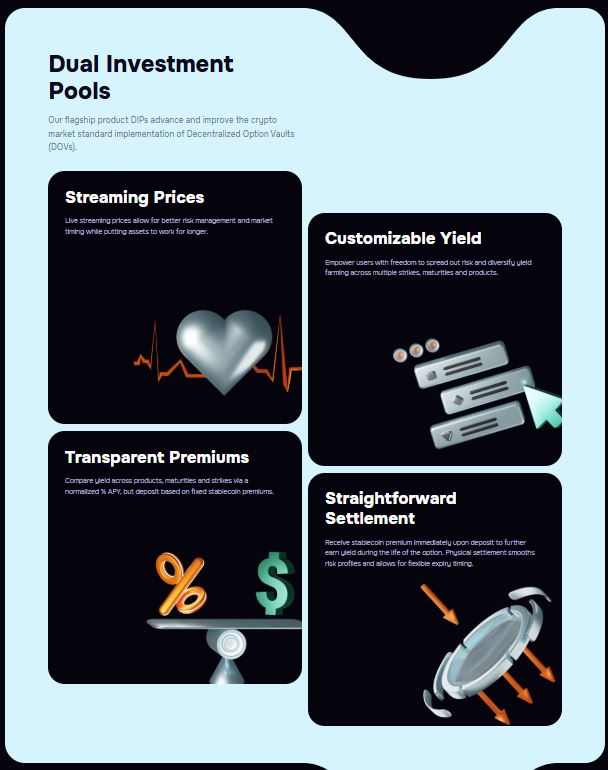
The protocol’s flagship product is DIPs (Dual Investment Pools), which are a more capital-efficient and risk-neutral implementation of Decentralized Option Vaults (DOVs) . The platform also offers structured products for yield generation and a loyalty rewards system aimed at DAOs and project tokenomics .
Key takeaway: DUAL isn’t trying to be the next Jupiter or Raydium. It’s building infrastructure for incentive liquidity, a niche but critical piece of the DeFi puzzle.
When Did DUAL Finance Launch?
DUAL Finance was founded in 2022 . The team spent its early days competing in and winning Solana DeFi and Chainlink hackathons, which helped validate both the technical approach and the market need .
The first major milestone came on March 2, 2023, with the launch of the Community Seed Airdrop (CSA). This event marked the first distribution of DUAL tokens to users . Notably, the project deliberately avoided announcing VC backers or foundation allocations, aiming for a fair launch with no insider advantage .
By early 2026, the project had matured enough to attract centralized exchange attention. Kraken listed DUAL for trading on March 31, 2026, giving the token broader market access .
As of late 2026, the protocol maintains 100% uptime over the last 30 days, with a valid SSL certificate and active website .
Which Assets Does DUAL Finance Support?
This is where I need to be direct: DUAL Finance is not an asset-agnostic DEX. You can’t just swap any Solana token here like you would on Jupiter or Raydium.
DUAL supports assets within the context of its structured products and options pools. The platform operates on Solana, which means all transactions benefit from the network’s low fees and high throughput, a critical advantage for options strategies that require frequent on-chain interactions .
The core assets involved are:
- DUAL: The native governance and utility token. It’s used for fee payments, staking rewards, and DAO governance .
- Partner protocol tokens: Projects that integrate with DUAL’s Staking Options infrastructure use their own tokens as the underlying assets for incentive programs .
- Stablecoins: DIPs settle premiums in stablecoins, and users deposit collateral that can include stablecoin pairs .
If you’re looking for a simple “buy token X with token Y” experience, DUAL isn’t that. It’s an options infrastructure layer. The assets it “supports” are the ones that flow through its structured product pools and partner incentive programs.
Fees for Transfers and Swaps
Let’s address the fee question head-on. This is where I need to correct a common misconception.
DUAL Finance is not a swap platform in the traditional sense. You won’t find a “swap” button that charges a 0.3% trading fee like Uniswap. Instead, the economics work differently.
According to a Shariah compliance analysis of the protocol, DUAL’s revenue comes from a flat $0.02-equivalent minting fee charged in DUAL for creating objects on the network. The fee distribution is transparent and on-chain:
| Fee Recipient | Percentage |
|---|---|
| Stakers | 90% |
| Dual DAO Foundation Treasury | 10% |
For private deployments, the revenue split changes to 50/50 with operators . This makes sense from a business perspective, enterprise clients need custom arrangements.
The critical point: there are no traditional “transfer fees” or “swap fees” in the way you’d expect from a DEX. Costs are tied to object creation and participation in structured products. When you deposit into a DIP, you receive stablecoin premiums immediately, which can then be deployed elsewhere during the option’s life .
Practical implication: If you’re evaluating DUAL for yield, your cost basis is the opportunity cost of capital locked in structured products, plus the underlying Solana network fees (which are negligible). The $0.02 minting fee is a rounding error for most users.
Why DUAL Finance Matters
I don’t hype projects. Most DeFi “innovations” are just recycled ideas with a new logo. DUAL is different for one reason: it solves a real structural problem.
The problem: Token incentives are extractive by default. Free tokens attract mercenary capital. Mercenary capital sells. Token dies.
The DUAL solution: Distribute Staking Options instead of tokens . Recipients get the right, but not the obligation, to purchase tokens at a future price. This does two things:
- Reduces immediate sell pressure: Recipients can’t dump what they don’t have.
- Aligns incentives: Option holders benefit only if the token appreciates, creating genuine long-term alignment.
For DAOs and protocol treasuries, this is a game-changer. Instead of burning through token reserves on emissions that get dumped, they can structure incentives that reward actual participation and long-term holding .
The Risk Manager component further strengthens the model by serving as a protocol market maker for CLOBs (Central Limit Order Books), helping to strengthen both options and spot liquidity for partner tokens .
This isn’t just theoretical. DUAL’s approach has been recognized as “non-dilutive”, a rare quality in DeFi token distribution . For projects that care about sustainable tokenomics, DUAL provides tooling that simply didn’t exist before.
Online Reviews and Community Sentiment
Let me be transparent: DUAL Finance is not a mainstream, high-volume protocol. It’s specialized, and its user base reflects that. Here’s what the data shows.
Platform Ratings
On MadeOnSol, DUAL Finance holds a 5.0★ rating based on a small sample of reviews. The platform scored 88/100 on the site’s health and functionality assessment .
One user review summarized the sentiment: “Free access to structured products on Solana? DUAL Finance is built different” .
The site highlights both pros and cons honestly:
Pros:
- Options-based incentives reduce immediate sell pressure
- Purpose-built tooling for DAOs and project tokenomics
- Structured products add yield-generation options
- Solana’s low fees and fast execution suit options strategies
Cons:
- Options and structured products are complex, advanced instruments
- Smart-contract risk and variable, non-guaranteed yields
- Specialized protocol may have less liquidity than mainstream DEXs
Social Activity Concerns
One data point caught my eye: social activity was marked as “Inactive (176 days ago)” as of late 2026 .
This is a yellow flag. A protocol with inactive social channels either has a very quiet community or has shifted its communication strategy entirely. For a DeFi project, visible community engagement matters, not for hype, but for transparency and responsiveness.
Scam Warnings (Important)
I need to flag something critical. There are scam websites attempting to impersonate DUAL Finance.
ScamAdviser has issued warnings for trustwallet-dual.com and dualfund.online, both of which have extremely low trust scores (1/100 and 9/100 respectively) . These sites are young, use hidden WHOIS data, and have no legitimate connection to the actual protocol.
Always verify you’re on the correct domain before interacting. The official project is at dual.finance. If a site promises “trust wallet integration” or uses a different URL, assume it’s a scam.
The Reclame Aqui Confusion
I also found a complaint on Reclame Aqui (a Brazilian consumer protection site) about a “Dual” app charging fees without granting access . After reviewing the details, this appears to be unrelated to DUAL Finance the DeFi protocol, likely a different app or service using the same name. Context matters.
Conclusion
DUAL Finance is not for everyone. If you’re a casual DeFi user looking for simple yield farming or token swaps, this isn’t your platform. The options and structured products require genuine DeFi knowledge, and the learning curve is real .
But if you’re a DAO contributor, protocol treasury manager, or tokenomics nerd, DUAL offers something genuinely differentiated. The Staking Options mechanism is a legitimate innovation in incentive design. The fee model is transparent and community-aligned. The Solana foundation provides the speed and cost efficiency that options strategies demand.
My assessment: DUAL Finance is a specialist tool with real utility for a specific audience. It’s not a moonshot. It’s infrastructure. Evaluate it accordingly.
Frequently Asked Questions
Find simple answers to common questions about DUAL Finance, DUAL tokens, staking options, fees, structured products and the Solana DeFi ecosystem.
DUAL Finance is a decentralized options protocol on Solana that specializes in options-based token incentive programs. Its flagship product, DIPs (Dual Investment Pools), provides structured product pools designed for yield generation and community incentives.
DUAL Finance was founded in 2022. Its Community Seed Airdrop launched on March 2, 2023, marking the first distribution of DUAL tokens.
DUAL Finance charges a flat $0.02-equivalent minting fee paid in DUAL for creating objects on the network. Of these fees, 90% goes to stakers and 10% goes to the DAO Foundation Treasury. DUAL Finance does not charge traditional swap or transfer fees.
DUAL Finance is a DeFi protocol with named leadership, a defined fee model and exchange listings. However, fraudulent websites and accounts can impersonate legitimate crypto projects. Users should verify links carefully and use the official DUAL Finance domain, dual.finance, when accessing the protocol.
DUAL is used for governance within the Dual DAO, paying protocol fees and participating in staking-related rewards. The token is distributed through options-based mechanisms rather than relying solely on unrestricted token emissions.
No. DUAL Finance is not designed to operate as a traditional token swap platform. Its focus is structured products, options and token incentive infrastructure. For token swaps on Solana, users can use dedicated decentralized exchanges and aggregators such as Jupiter or Raydium.
DUAL Finance’s core innovation is Staking Options, a token incentive mechanism that distributes options instead of simply distributing free tokens. This structure is designed to reduce immediate sell pressure and better align long-term incentives between protocols and their communities.
DUAL is available for trading on supported cryptocurrency exchanges, including Kraken, which listed the token on March 31, 2026. Availability can change over time, so check the official DUAL Finance channels for the latest list of supported exchanges and decentralized trading platforms.