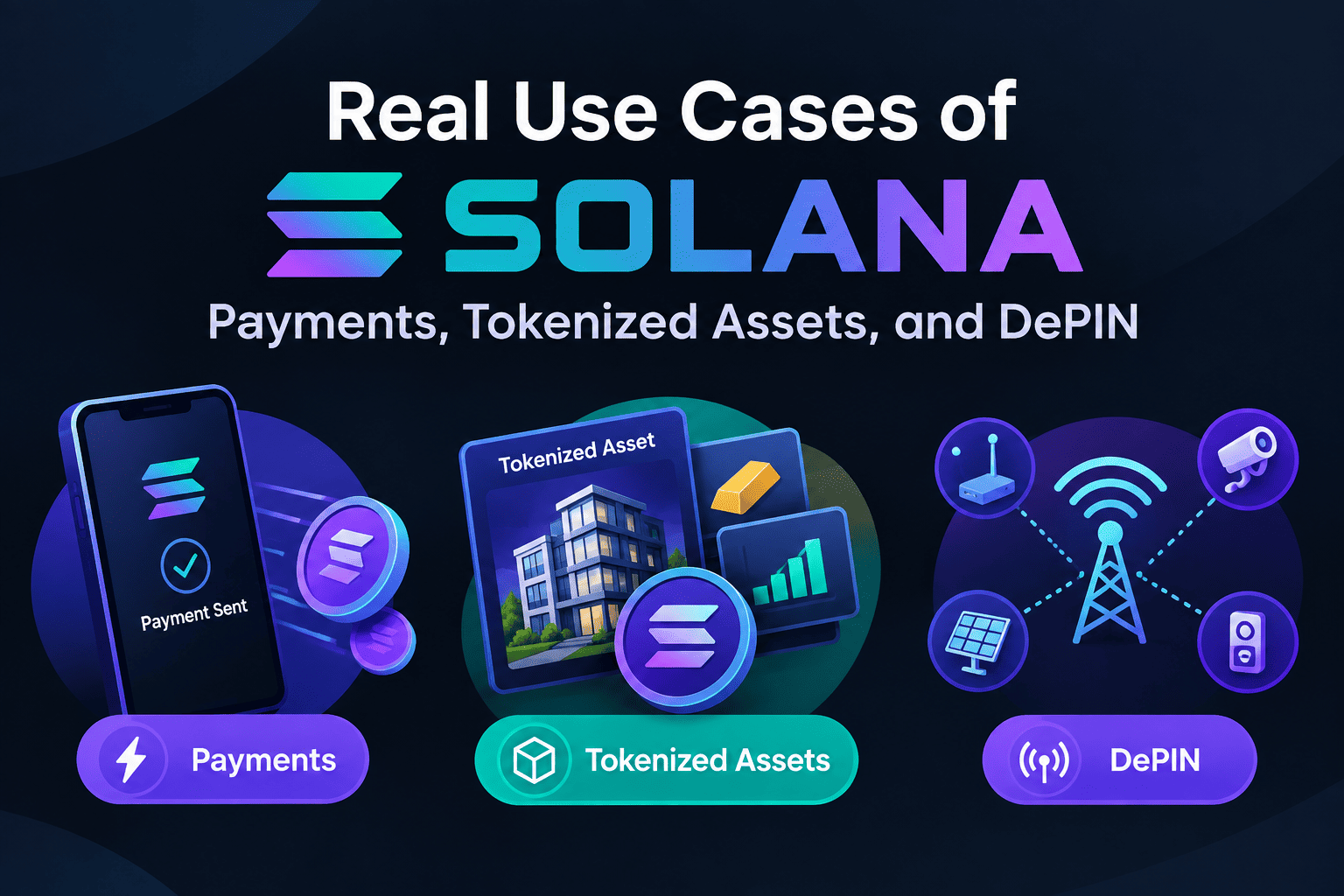
Real Use Cases of Solana: Payments, Tokenized Assets, and DePIN in 2026
For years, the crypto industry has been criticized for building technology in search of a problem. Solana appears to have found the opposite dynamic: real problems demanding infrastructure that can actually handle them.
The network’s August 2026 numbers tell a story that goes well beyond speculative trading. According to Solana’s own ecosystem data, the blockchain processed a record 216 million daily non-vote transactions and 1.32 billion weekly non-vote transactions during the week of August 17-23 . Those aren’t bot-generated volume spikes. They represent payments moving, assets settling, and infrastructure operating.
Here are the real use cases driving that activity.
Payments: From Remittances to Recurring Billing
The most tangible shift on Solana is in payments. Western Union, a company synonymous with traditional remittances, launched Stablecard in August 2026. It’s a digital wallet and Visa secured credit card powered by USDPT, Western Union’s stablecoin issued by Anchorage Digital on Solana. The product launched in 37 markets and works anywhere Visa is accepted .
MoneyGram went further. Through MoneyGram Ramps, Solana applications now access a single API for moving between cash and crypto. That network covers nearly 500,000 locations in more than 170 countries, serving over 60 million customers . This is the cash-to-crypto bridge that mainstream adoption requires.
Visa’s involvement adds institutional weight. In December 2025, Visa launched USDC settlement in the United States, with Cross River Bank and Lead Bank as initial participants settling over Solana . Visa noted its monthly stablecoin settlement volume had passed a $3.5 billion annualized run rate .
Mastercard followed in June 2026, adding Solana as one of eight networks for regulated stablecoin settlement. The company cited Solana’s 76% share of stablecoin transfer activity on its own network and roughly 35% of all on-chain stablecoin transfers globally .
Solana also built the plumbing for recurring commerce. Subscriptions & Allowances went live on mainnet in June 2026, enabling native recurring billing, payroll, and AI agent spending limits without third-party processors. Helius and Confirmo are already integrating it .
The aggregate numbers are striking: Solana processed more than $5 trillion in stablecoin volume in 2026 alone, according to the Solana Foundation .
Tokenized Assets: The $4 Billion Reality
Solana’s real-world asset (RWA) value passed $4 billion during August 2026, with more than 350,000 addresses holding tokenized assets on the network . By late September, that figure had grown to $4.5 billion .
xStocks, the tokenized equity platform, crossed $500 million in assets under management across more than 700 tokenized stocks and ETFs, held by over 190,000 holders on Solana . Raydium surpassed $4 billion in cumulative tokenized-stock volume .
The equity tokenization goes deeper than retail speculation. Securitize, which began trading on the NYSE under ticker SECZ in July 2026, made tokenized SECZ available on Solana. The tokenized position represents the same common stock, making Securitize the first newly public company to bring its own stock onchain from day one .
Institutional fixed income arrived with J.P. Morgan arranging a $50 million U.S. commercial paper issuance for Galaxy Digital on Solana in December 2025. J.P. Morgan described it as one of the earliest debt issuances on a public blockchain and among the first in the U.S. to use blockchain for securities issuance and servicing .
Moody’s Ratings expanded its Token Integration Engine to Solana in June 2026, making credit ratings machine-readable on-chain through Alphaledger. It marked the first time Moody’s ratings could be integrated on a major public permissionless blockchain .
Project Harmonia, announced in September 2026, connects Allfunds, the world’s largest fund distribution network with €1.9 trillion in assets under administration, directly to Solana. The program makes tokenized funds distributable at institutional scale with a single integration .
DePIN: Physical Infrastructure That Actually Works
Decentralized Physical Infrastructure Networks (DePIN) on Solana generated $2.8 million in revenue in April 2026, with data offload activity up 17x year-over-year . The cumulative tracked DePIN revenue since January 2025 exceeded $22 million by mid-2026 .
Helium Mobile leads the category with over $14 million in cumulative revenue since January 2025, frequently exceeding $2 million per month. It accounts for roughly two-thirds of all DePIN revenue on Solana . In August 2026, io.net generated $9.4 million in 30-day revenue, followed by GEODNET at $8 million and Dabba Network at $7.5 million .
DeCharge represents a newer model. The platform tokenizes EV charging infrastructure, with pools backed by distributed chargers whose utilization is tracked through live telemetry on-chain. It currently routes roughly 25 MW of active charging capacity, with a goal of 100 MW and an estimated $120-$150 million in annual energy savings .
AI Agent Commerce
Solana is positioning itself as the settlement layer for AI agents that need to transact. The x402 Foundation opened under the Linux Foundation in July 2026, with the Solana Foundation joining Visa and Stripe as premier members .
Ramp began testing agent wallets for business customers in August 2026, allowing companies to fund wallets, set spending controls, and record x402 purchases made by AI agents on Solana . MoonPay Commerce reported over $40 million in single-payment volume since October 2025, with 88% on Solana .
Solana’s Subscriptions & Allowances primitive directly addresses agent spending. Allowances let users pre-authorize a spend cap with expiration, enabling autonomous agents to operate within bounded budgets without human intervention .
Consumer Applications Beyond Finance
The World Series of Poker ran its first Solana Showdown in 2026. Across the season, Solana processed $22.9 million in buy-ins across 6,176 tournament entries .
Meta added support for USDC payments on Solana for creators in Colombia and the Philippines in April 2026 . MetaMask Card added Solana USDC support for eligible U.S. users, spendable anywhere Mastercard is accepted .
KSNET, a Korean payment provider, agreed to integrate Solana Pay across a merchant network with more than 330,000 locations .
Why Solana
The common thread across these use cases is throughput and cost. Median fees on Solana sit near $0.0004, with blocks confirming in roughly 400 milliseconds . In July 2026, Solana raised its block limit by 66%, from 60 million to 100 million compute units . The target slot time was reduced to 300 milliseconds in August, down 25% over eight days .
Those specifications matter because real-world finance cannot wait. Payroll runs on schedules. Card settlements happen on weekends. Tokenized equities need 24/7 trading. AI agents require sub-second finality.
Solana Foundation President Lily Liu calls this the “Token Supercycle” : the migration of money, assets, and ownership onto always-on internet infrastructure . The appointments of former Binance executive Rachel Conlan as Chief Strategy Officer and former Polygon executive Jamal Raees as General Manager of Payments in September 2026 signal that the foundation is staffing for institutional scale, not crypto-native experiments .
The numbers support the thesis. Charles Schwab, serving nearly 40 million active accounts with $13 trillion in client assets, plans to add SOL to Schwab Crypto Direct . SBI Holdings is building a Japan-originated onchain financial market on Solana with Sumitomo Mitsui Financial Group .
Solana’s real use cases are no longer about what the network could do. They’re about what it already does, at scale, with institutional partners, and with real money moving across them.